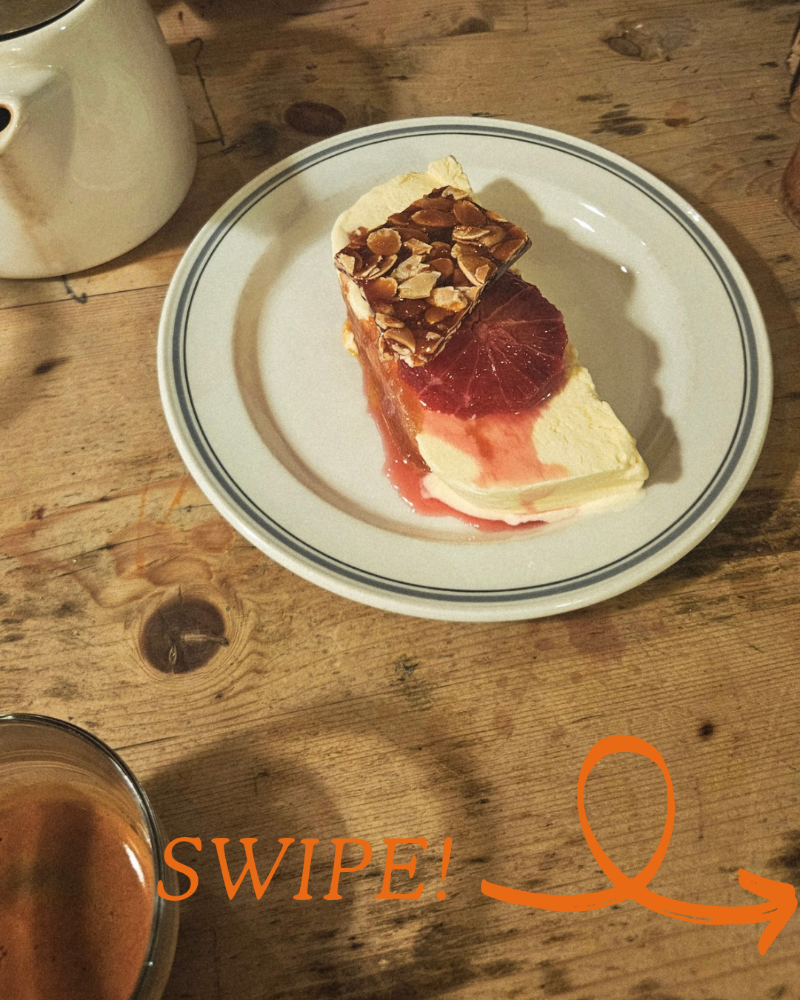
Blood oranges, the one that got away. The season is a welcome, yet fleeting, breath of fresh air in the dark tunnel-vision of February. With hues ranging from a glorious crimson to barely blushing pink, they’re a sweet and refreshing lifeline; here to pull us through the last few weeks until we see the first of the British rhubarb sleepily pushing their heads up, blinking in the early spring sunshine.
We use a mix of varieties, from the richly dark Moro, almost maroon in its ruby depths, to the more reserved yet subtly sweeter Tarocco, to the striking tiger-like streaks of Sanguinello. All the way from the foothills of Mount Etna in Sicily, they’re rare and much-anticipated trophies. Ours are grown by Agrinova Bio 2000, an agricultural cooperative of producers and agronomists based in the East of Sicily dedicated to growing organic produce. They cultivate a variety of crops, including courgettes, grapefruit, and oranges, with a special emphasis on Sicily’s renowned lemons and blood oranges. In this respect, founder Francesco Ancona strongly emphasises the need to adapt the product to the land rather than the other way round.
“The policy we have always pursued is to analyse the soils in the different regions and to encourage producers to grow products which suit those soils.”
I think it’s a good example of how imported fruit can sometimes be better than trying to force something to grow where it doesn’t suit the land or the climate, relying on chemical inputs or heated greenhouses.
Forgotten marmalade (makes about 2x 1l jars)
The thin skins and short season of blood oranges make them an ideal candidate for a particularly awesome marmalade. This February, each time you peel an orange or a grapefruit, put the peel in a reused plastic tub or sandwich bag in the freezer. Once you’ve saved up a good amount, capture the sunshine of Sicily all the way through March and into April until we start to see the first spring berries. I can’t wait!
I don’t always insist on organic, but this is one of those times. Conventionally-grown citrus fruits are grown with a lot of chemicals, particularly the fungicide imazalil, a known cause of cancer and a developmental and reproductive poison used to coat the skins of oranges and lemons to kill mould during transport. (Pesticide Action Network UK) Oranges are also heavily treated with 2,4-D, the main ingredient in the notorious Agent Orange used by the USA to destroy massive areas of rainforest during the Vietnam war. Stephen Hunt’s We Must Begin With the Land highlights these chemicals designed to kill, such as Nazi-era organophosphate insecticides being redeveloped as nerve agents, as an interesting link between imperialist struggles for dominance, chemical warfare and conventional agriculture. Sounds healthy.
- 1kg organic blood orange peel, sliced into 2-5mm strips – look for the Soil Association stamp
- 1.5kg demerara or rapadura sugar, or other minimally refined sugar like muscavado
- 2l water
Place the orange peel in your largest saucepan and cover with cold water. Bring to the boil and simmer for 1-2 hours, or until the peel is soft and translucent. Add the sugar, and continue to simmer until the mixture reaches 105C on a sugar thermometer. If you don’t have a thermometer, use a ladle to scoop a little of the marmalade onto a clean plate and put it in the freezer for 2 minutes. You should be able to cleanly draw a line through it with your finger and it holds its shape without flowing back. If it’s too runny, put it back in the pan, boil for another 10 minutes and check again.
Once you’re happy with the consistency, turn off the heat and leave to stand for 5 minutes. This helps to distribute the peel evenly throughout. Ladle the marmalade into sterilised recycled jam jars or Kilner jars and seal while still hot. Allow to cool completely. Unopened, they’ll last for years but you’ll most likely never know before it all gets eaten. Once opened, store in the fridge for up to 6 months.
Hazelnut ice cream (serves 4-6)
The aquafaba is optional here, but the air helps to stop the ice cream freezing solid and gives it a lighter, softer texture. You can buy aquafaba as an egg white substitute, but why would you? Simply soak 200g dried chickpeas or beans and simmer in 1l water until cooked. Allow to cool completely in the water, then strain and save the beans for another time.
- 150g hazelnut butter or whole toasted hazelnuts
- 100g maple syrup, honey or other unrefined sugar of choice
- 50g aquafaba, whipped until soft peaks form.
- 2-3tbsp forgotten marmalade
- Fresh oranges and toasted hazelnuts, to serve.
Place the nuts or nut butter, maple syrup and 1tbsp of the marmalade into a blender with 400ml water and blend until smooth. Pour into a mixing bowl and gently fold in the whipped aquafaba. Churn in an ice cream maker until set.
While the ice cream is churning, line a rectangular plastic tub or loaf tin with compostable greaseproof paper. Beat the other 2tbsp marmalade in a small bowl with 1tsp water to loosen. Once the ice cream is set, fold in the marmalade and pour the mixture into the loaf tin and freeze until set.
If you don’t have an ice cream maker, spoon the aquafaba mixture into ice cube trays and freeze solid. Blend on maximum speed until smooth, and either refreeze in the lined tin or serve in tall glasses with a few slices of orange, slushie-style.
To serve, turn the parfait out of the tin onto a chopping board and peel off the paper. Slice into 4-6 slices and garnish with some toasted hazelnuts and a few orange slices.