Paul circles his target like a seasoned hunter, searching for an opening. Eyeing the tangled thicket of apple and blackthorn, he fixes on his prey: the root stock from this fruit tree has grown into another tree competing with the quince in the same spot.
Look at that, those trees are so close together they’re rubbing each other’s bark off in the wind. He needs to go-
As if to underline his point, the loppers snap shut and the offending branch falls to the ground amongst last year’s fruit. Slowly, the young apple tree starts to emerge, the overbearing blackthorn tamed until next year.
Each Tuesday morning, I flit between baking for the food bank and helping to manage our community orchard. There are the usual suspects of apples and pears, but there’s a few quince and damsons, a medlar, even an almond tree! The cherry is just coming into bloom, the delicate pink buds just in time to see the end of the rainy winter and this bright, clear, frosty morning and nicely meeting up with Pancake Day.
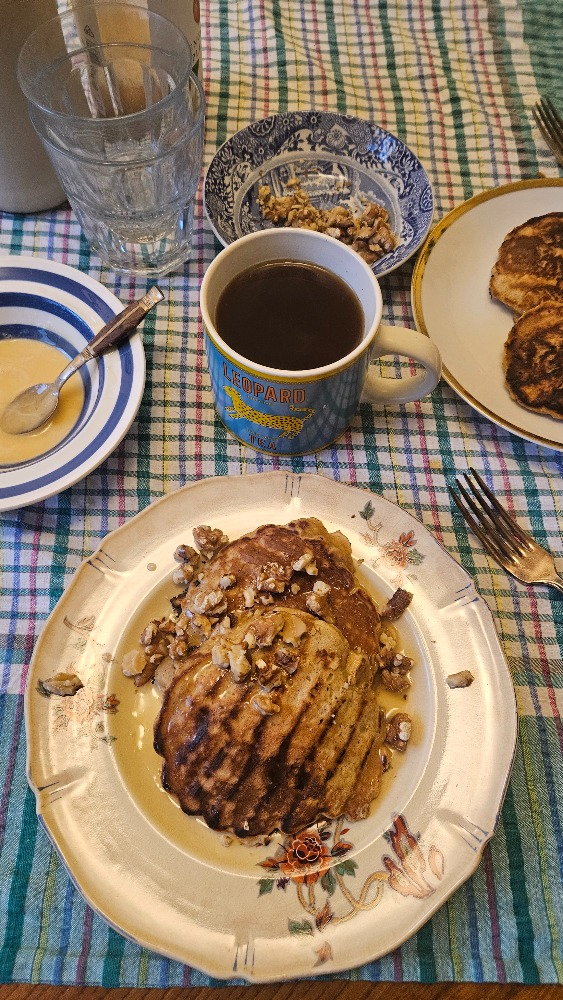
Apple pancakes with walnuts and honey (serves 4)
Nonpareil, Winter Pomeroy, The Harvey. Cox’s Pippin, Winter Pairmain, Carabeit. Thanks to the dedication of Victorian gardeners, Britain once cultivated more varieties of apple than anywhere else in the world: more than 2,000 types of apples with all sorts of tastes, textures, shapes and sizes. For eating, there were Pitmaston Pineapples, Ribston Pippins or the Laxton’s Superb, a red-flushed, sweet, crisp dessert apple. For cooking and juicing, the Alfriston was a large, sharp apple that made wonderful juices and smooth purées, or the Howgate Wonder, a super-sized cooker that was great for pies and tarts.
Even before that, villages in the cider-producing counties of the West Country would gather in early spring, to sing and drink the health of their community orchard in the hopes that the trees might better thrive. During the wassail, sometimes just called howling, we would sing hymns, bang pots and pans together, drink and fire gun salutes to wake up the apple trees and scare away evil spirits to ensure a good harvest later in the year.
What a shame that today, Britain imports over 70% of the apples we consume. A quick glance around the supermarket shelves reveals much about our limited choice, with the Bramley being the only cooker on offer, along with only a handful of samey tasting, waxy looking eating apples, usually from South Africa or Europe.
See how many different kinds of apples you can collect this Pancake Day – happy wassailing! Grating fruit into the pancake batter makes for squdgier, fruiter cakes without imported (and expensive) maple syrup. They’re a little reminiscent of a traditional English apple pie, with added crunch of walnuts and sweet honey from the orchards.
- 200g white spelt, einkorn or buckwheat flour
- 1 1/2 tsp baking powder
- 2tbsp demerara or rapadura sugar
- 1tbsp sultanas
- 1tsp ground mixed spice
- 150ml hazelnut milk
- 50ml olive oil or melted butter
- 3 apples or pears, cored and grated
- Yogurt, natural honey and chopped walnuts, for sprinkling
In a large mixing bowl, combine the flour, baking powder, sugar and spice. Add the milk, oil, sultanas and grated apple, plus any juice. Beat the eggs and mix these in too.
Set a large frying pan over a medium heat. Add a little butter or oil, then dollop in some of the batter to make 3 pancakes about 10cm across. Add a little more mix to each cake to make it slightly thicker and cook for 2 minutes, waiting for bubbles to rise to the surface before carefully flipping each one over. Cook for another minute until cooked through. Remove and repeat until all the batter is cooked. Top with a dollop of yogurt, drizzle over the honey and sprinkle over the chopped nuts.
Here’s to thee, old apple tree,
Whence thou mayst bud
And whence thou mayst blow!
And whence thou mayst bear apples enow!
Hats full! Caps full!
Bushel—bushel—sacks full,
And my pockets full too! Huzza!
— South Hams of Devon, 1871